

10 Best Poly Septic Tanks for Global Buyers
Choosing a reliable poly septic tank requires more than comparing price, capacity, and delivery times. Global buyers must assess soil conditions, household loading, groundwater levels, climate, and local installation requirements. The WHO and UNICEF Joint Monitoring Programme reported that 3.5 billion people lacked safely managed sanitation in 2022. That figure shows why durable, decentralized wastewater systems remain important in many regions.
Material performance matters.
High-density polyethylene and other rotationally molded plastics can resist corrosion, moisture, and many household chemicals. Their lighter weight may reduce transport and lifting costs, especially on remote projects. However, a lightweight tank can shift or deform when groundwater rises. Correct anchoring, bedding, backfilling, and access-port design are not optional details. They determine real-world service life.
The U.S. Environmental Protection Agency states that septic systems serve nearly one-quarter of American homes. Its guidance emphasizes proper design, installation, inspection, and maintenance. UN-Water’s GLAAS 2022 report also identified continuing sanitation financing and management gaps worldwide. These findings support a careful, evidence-based buying process rather than a simple “best seller” ranking. This guide compares ten poly septic tank options through practical criteria, including structural strength, usable volume, certification, maintenance access, freeze resistance, and supplier support. Standards such as EN 12566-1 and relevant national requirements may help, but certification coverage differs by market. Some manufacturer claims remain difficult to verify. That is worth admitting. A tank that performs well in one soil profile may fail in another without professional site assessment.
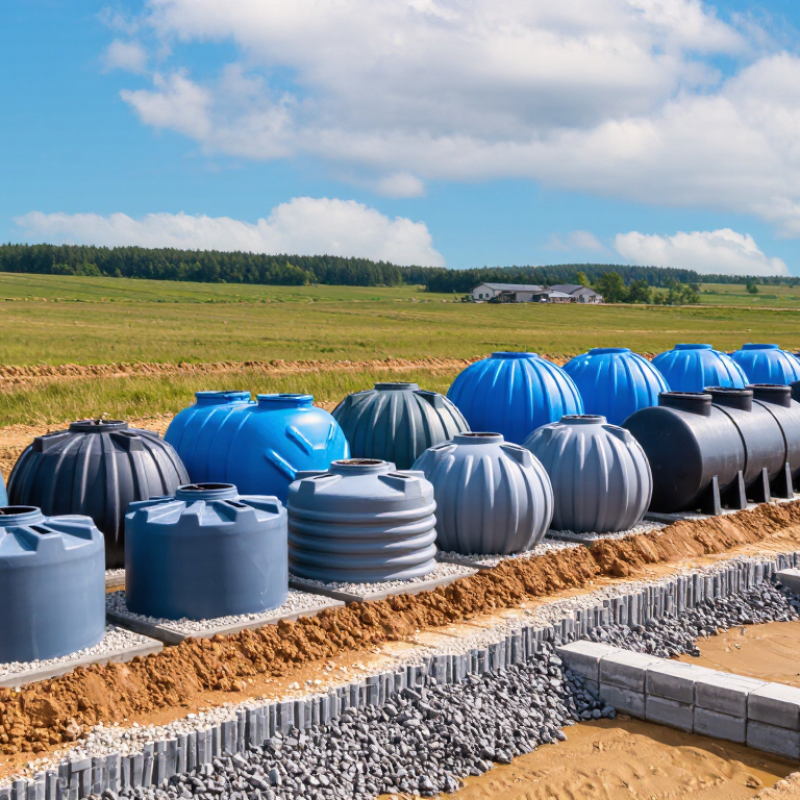
What Are Poly Septic Tanks and How Do They Work?
Poly septic tanks are underground wastewater chambers made from polyethylene, usually high-density polyethylene. Manufacturers form them in one piece, reducing welded seams and potential leak paths. Their smooth interior resists corrosion from wastewater, soil moisture, and household chemicals. They are also lighter than concrete tanks, which can simplify transport and placement.
The process is simple, but not careless. Wastewater enters through the inlet pipe and slows inside the tank. Heavy solids settle as sludge, while grease and lighter materials float as scum. Anaerobic bacteria break down part of the organic matter in the middle liquid layer. Clarified effluent then leaves through an outlet filter and moves into a drainfield for soil treatment. It is not magic. The soil does much of the final work.
The U.S. Environmental Protection Agency reports that nearly one-quarter of U.S. households use septic systems. Its Decentralized Wastewater Treatment Systems report also identifies poor maintenance and hydraulic overloading as common causes of failure. That evidence matters for global buyers. A poly tank may resist corrosion, but it can still deform, float, crack, or lose connections when installation is wrong. I would not treat “watertight” as “failure-proof.” Check local loading requirements, groundwater conditions, access for pumping, and certified testing before selection. ASTM and other regional standards can provide useful benchmarks, but they do not replace site engineering. In field practice, the inlet, outlet, cover, and anchoring details deserve the closest inspection.
10 Best Poly Septic Tanks for Global Buyers - What Are Poly Septic Tanks and How Do They Work?
A practical comparison of common polyethylene septic-tank configurations for residential, seasonal, and light-commercial applications
| Rank | Poly Tank Configuration | Typical Nominal Capacity | Indicative Tank Envelope | Typical Empty Weight | Best-Fit Application | Key Design Features | How It Works in a Septic System | Important Installation Considerations |
|---|---|---|---|---|---|---|---|---|
| 1 | Compact Single-Compartment Tank | 500 gal / 1,893 L | Approx. 7–9 ft long × 5–6 ft wide × 5–6 ft high | Approx. 250–450 lb / 113–204 kg | Small seasonal cabins, guest units, and low-occupancy properties | Space-saving Rotationally molded polyethylene One or more inspection/access openings |
Wastewater enters the tank, heavy solids settle as sludge, lighter grease and scum float, and clarified liquid leaves through the outlet toward a drainfield. | Confirm local minimum capacity, daily flow, groundwater conditions, and approved burial depth before purchase. |
| 2 | Large Single-Compartment Tank | 750 gal / 2,839 L | Approx. 8–10 ft long × 5–6 ft wide × 5–6.5 ft high | Approx. 300–550 lb / 136–249 kg | Small homes, holiday properties, and low-flow residential systems | Simple layout Low corrosion risk Suitable for gravity-flow arrangements |
The tank provides detention time for sedimentation and natural anaerobic breakdown before effluent is distributed to the soil treatment area. | A 750-gallon tank may not meet residential regulations in every jurisdiction; sizing must follow occupancy and code requirements. |
| 3 | Standard Residential Tank | 1,000 gal / 3,785 L | Approx. 10–12 ft long × 5–6 ft wide × 5.5–6.5 ft high | Approx. 350–650 lb / 159–295 kg | Typical two- to three-bedroom homes, subject to local rules | Common size Two access points are often available Inlet and outlet baffles or tees |
Solids are retained in the primary chamber while liquid effluent passes through the outlet structure after partial biological treatment. | Provide a stable, level base and use approved backfill. Do not assume a polyethylene tank is traffic-rated without written confirmation. |
| 4 | Two-Compartment Residential Tank | 1,250 gal / 4,732 L | Approx. 11–13 ft long × 5–6.5 ft wide × 6–7 ft high | Approx. 450–750 lb / 204–340 kg | Medium-size homes requiring improved solids separation | Two-stage settling Internal partition Separate inspection access for chambers |
The first chamber captures most solids; the second chamber receives partially clarified wastewater and reduces solids carryover to the drainfield. | Ensure the partition, transfer opening, outlet filter, and access risers remain serviceable after burial. |
| 5 | High-Capacity Residential Tank | 1,500 gal / 5,678 L | Approx. 12–15 ft long × 6–7 ft wide × 6–7 ft high | Approx. 550–900 lb / 249–408 kg | Large homes, high-occupancy residences, and properties with variable water use | Longer retention time Large access openings Optional effluent-filter housing |
Greater liquid volume allows more time for settling and biological activity, helping protect the downstream soil absorption system. | Use a professional structural assessment where groundwater is high, burial is deep, or occasional vehicle loading is possible. |
| 6 | Heavy-Duty Two-Compartment Tank | 1,750 gal / 6,624 L | Approx. 13–16 ft long × 6–7 ft wide × 6.5–7.5 ft high | Approx. 650–1,050 lb / 295–476 kg | Large residences, shared dwellings, and light-use rural facilities | Higher working volume Partitioned treatment zone Accessible inlet and outlet assemblies |
Primary settling occurs in the first compartment, while the second compartment provides additional clarification before discharge to the drainfield or further treatment. | Check lifting requirements, access-road conditions, soil bearing capacity, and local requirements for secondary treatment. |
| 7 | Large Residential / Small Commercial Tank | 2,000 gal / 7,571 L | Approx. 14–18 ft long × 6–8 ft wide × 6.5–8 ft high | Approx. 750–1,200 lb / 340–544 kg | Multi-bedroom homes, small offices, and low-flow accommodation facilities | High-flow tolerance Multiple access risers Large-diameter inlet and outlet connections |
The tank equalizes short-term flow variations, retains settleable solids, and sends clarified effluent to a properly designed soil or advanced treatment system. | Commercial applications normally require an engineered design, flow estimate, inspection access, and a permitted effluent-disposal method. |
| 8 | High-Volume Two-Compartment Tank | 2,500 gal / 9,464 L | Approx. 15–19 ft long × 7–8 ft wide × 7–8 ft high | Approx. 900–1,450 lb / 408–658 kg | Large homes, small lodges, and properties with substantial peak flows | Large storage reserve Two-stage settling Suitable for serviceable effluent filtration |
Extended detention supports separation of solids and scum while the outlet assembly limits suspended solids entering the next treatment stage. | Tank flotation resistance is critical in wet soils; follow the manufacturer’s anchoring and groundwater-control instructions. |
| 9 | Modular or Multi-Tank System | 3,000 gal / 11,356 L total | Two or more tanks; each unit commonly 1,000–1,500 gal | Approx. 700–1,800 lb / 318–816 kg total | Sites with restricted access, phased construction, or flexible capacity needs | Flexible logistics Separate primary and secondary tanks Expandable layout |
Individual tanks can provide sequential settling, pumping, dosing, or additional treatment while allowing capacity to be distributed across the site. | Hydraulic balancing, pipe elevations, venting, access, and anti-flotation measures must be designed as one complete system. |
| 10 | Large Poly Holding or Pretreatment Tank | 4,000 gal / 15,142 L | Approx. 18–24 ft long × 8–10 ft wide × 8–10 ft high | Approx. 1,200–2,200 lb / 544–998 kg | High-flow facilities, equalization service, or systems requiring additional pretreatment volume | Maximum volume Large service openings Can be configured for pumping or staged treatment |
Depending on the design, the tank stores wastewater temporarily, equalizes incoming flow, or provides an additional settling stage before downstream treatment. | A holding tank is not automatically a complete septic-treatment system; pumping frequency, alarms, backup power, and final disposal must be engineered. |
Note: Capacities, dimensions, and weights are indicative ranges for common polyethylene septic-tank configurations. Actual specifications vary by tank geometry, wall design, access risers, fittings, burial depth, and loading requirements. Final selection should comply with the regulations of the installation country and be confirmed by a qualified wastewater professional.
Related Posts
-
What Is the Best Poly Septic Tank from China?
-
Top Water Tank Manufacturers in China for Global Buyers
-
Top Tips for Choosing the Best Poly Tanks for Your Needs?
-
2026 How to Choose the Right Poly Tanks for Your Needs?
-
Top Tips for Choosing Large Water Storage Tanks?
-
Top 10 Liquid Storage Tanks of 2025: Ultimate Guide for Efficient Storage