

What Are the Top Plastic Water Tank Types in 2026?
Water storage is becoming a practical priority, not merely a construction detail. The WHO and UNICEF Joint Monitoring Programme reported that 2.2 billion people lacked safely managed drinking water in 2022. Climate pressure makes local storage more valuable. A tank beside a home, farm, or factory can protect supply during interruptions.
This guide examines the top plastic water tanks expected to matter in 2026. It compares polyethylene, high-density polyethylene, polypropylene, and reinforced plastic designs. Each type behaves differently under sunlight, chemicals, temperature changes, and repeated filling. Rotomolded polyethylene tanks remain popular because they are lightweight, corrosion-resistant, and relatively easy to install. However, “low maintenance” does not mean maintenance-free. Sediment can collect at the base, and poorly supported tanks may deform.
Industry forecasts suggest continued growth in plastic water storage, although reported market values vary widely. Grand View Research and Fortune Business Insights both identify infrastructure upgrades, water scarcity, and residential demand as major growth drivers. Their estimates differ because some reports include industrial vessels, agricultural tanks, or rainwater systems. That uncertainty deserves attention.
Technical guidance matters more than attractive product photos. ASTM D1998 covers rotationally molded polyethylene tanks, while NSF/ANSI/CAN 61 addresses materials used with drinking water systems. These references help buyers assess wall strength, chemical safety, and intended use. Still, certification alone cannot fix an unsuitable foundation or excessive heat exposure. Small details matter. A shaded tank, level concrete pad, secure outlet, and accessible inspection opening can extend service life.
The best plastic water tanks in 2026 will not be identical. A household may need compact rainwater storage. A farm may need large UV-stabilized capacity. Industrial users may prioritize chemical resistance. This guide weighs those differences carefully, while recognizing that no single tank wins everywhere.
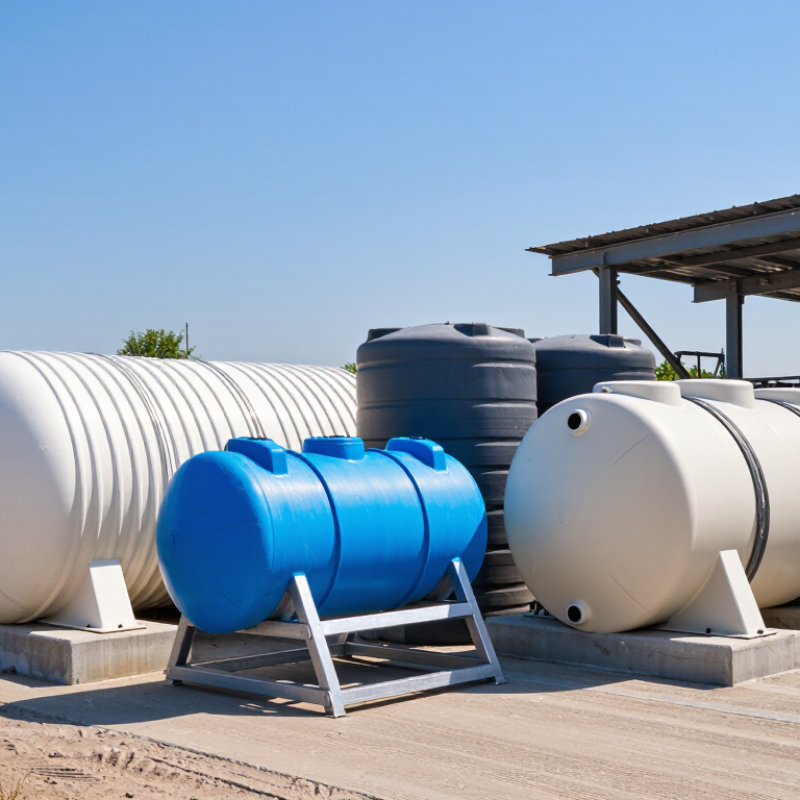
What Defines a Plastic Water Tank and Its Main Categories
A plastic water tank is a vessel made from synthetic polymer materials, designed to store water above or below ground. Its main job sounds simple: hold water without leaking or contaminating it. In practice, the resin, wall thickness, fittings, and installation all matter. A tank labeled for potable water should use materials intended for drinking-water storage; check its documentation rather than judging by color or appearance. Small details count.
Rotationally molded polyethylene tanks are common for homes, farms, and work sites. They are often seamless, lightweight, and available in vertical, horizontal, or slimline shapes. Polyethylene can suit many outdoor settings, though prolonged sunlight and local temperature swings make UV protection and placement worth checking. Modular panel tanks offer another category. Their sections can be carried through narrow access points and assembled on site, but joints and supports need careful installation. Fiberglass-reinforced plastic tanks are generally rigid and corrosion-resistant, while often requiring more planning for transport and setup. Shape is not the same as material type: a vertical tank and a horizontal tank may use the same polymer but fit different spaces. A detail is easy to miss. The best choice depends on water use, site access, foundation strength, and cleaning needs; no category is automatically right for every property.
What Are the Top Plastic Water Tank Types in 2026? – What Defines a Plastic Water Tank and Its Main Categories
| Plastic Tank Type | Primary Material | Typical Construction | Main Installation Position | Typical Capacity Range | Key Advantages | Common Water Uses | Important Selection Considerations |
|---|---|---|---|---|---|---|---|
| Linear Low-Density Polyethylene (LLDPE) | Rotationally molded polyethylene | One-piece, seamless tank with molded walls | Above ground; vertical, horizontal, or low-profile layouts | Approximately 100–25,000 L | Lightweight, corrosion-resistant, impact-tolerant, and available in many shapes | Potable water Rainwater, irrigation, livestock, and general storage | Choose potable-water certification where required; outdoor tanks should include UV stabilization and a suitable cover |
| High-Density Polyethylene (HDPE) | High-density polyethylene | Rotationally molded or fabricated panels; seamless and panelized designs are available | Above ground or underground, depending on the engineered design | Approximately 500–100,000+ L | High chemical resistance, low water absorption, and good durability in demanding environments | Potable water Process water, rainwater, wastewater, and agricultural storage | Underground installations require structural calculations, proper backfill, buoyancy control, and approved access covers |
| Polypropylene (PP) | Polypropylene | Heat-welded sheet, molded, or fabricated tank construction | Mostly above ground; indoor or protected outdoor locations | Approximately 100–50,000 L | Strong chemical resistance and useful performance at moderately elevated temperatures | Process water, treated water, chemical-adjacent applications, and selected potable-water systems | Confirm temperature limits, weld quality, UV protection, and potable-water approval for drinking-water service |
| Glass-Reinforced Plastic (GRP/FRP) | Thermoset resin reinforced with glass fibers | Filament-wound, molded, or sectional panel construction | Above ground; sectional models are suited to restricted-access sites | Approximately 1,000–1,000,000+ L | High stiffness-to-weight ratio, large-capacity capability, and resistance to many water-treatment environments | Potable water Fire reserves, municipal storage, industrial water, and treatment systems | Check liner type, resin approval, ultraviolet protection, panel sealing, and access for inspection and maintenance |
| Cross-Linked Polyethylene (XLPE) | Cross-linked polyethylene | Rotationally molded, one-piece construction | Above ground; commonly vertical or horizontal | Approximately 500–25,000 L | Good impact resistance, chemical resistance, and dimensional stability compared with conventional polyethylene designs | Potable water, agricultural water, rainwater, and selected chemical-service applications | Verify drinking-water compliance, UV resistance, wall thickness, fittings, and support requirements before installation |
| Flexible PVC or TPU Bladder Tank | Flexible PVC or thermoplastic polyurethane membrane | Flexible fabric bladder supported by a prepared base or outer structure | Ground-level, usually outdoors or inside a protected enclosure | Approximately 1,000–500,000 L | Rapid deployment, compact empty storage, and minimal excavation requirements | Potable water Emergency supply, rainwater, irrigation, and temporary storage | Requires a smooth foundation, protection from abrasion and sharp objects, controlled filling, and regular inspection |
A plastic water tank is a container manufactured mainly from polymeric materials for storing or managing water. Actual capacity, service life, temperature range, and potable-water suitability depend on the tank design, material grade, certification, installation conditions, and local regulations.
Related Posts
-
Why Choose Plastic Water Storage Tanks?
-
How to Choose the Best Plastic Water Tanks for Global Use?
-
How to Choose the Right Poly Tanks for Your Needs?
-
How to Choose the Best Plastic Storage Tanks?
-
What Are the Best Large Water Storage Tanks from China?
-
China Best Plastic Water Tanks for Global Buyers Guide?