Reliable water storage is becoming more important as cities expand, rainfall patterns shift, and supply networks face pressure. The WHO and UNICEF Joint Monitoring Programme reported that 2.2 billion people lacked safely managed drinking water in 2022. The United Nations World Water Development Report 2024 also identifies water scarcity and climate stress as growing global risks. These figures do not automatically prove that plastic tanks are the answer. They show why careful storage planning matters.
Peter Gleick, co-founder of the Pacific Institute and a leading water-resource expert, has said, “Water is a human right, and access to water is a basic human need.” His statement gives this product category a practical meaning. A large plastic water tank may support household supply, agriculture, construction, emergency reserves, or industrial processes. The right choice depends on capacity, tank geometry, material grade, UV exposure, fittings, installation surface, and cleaning access. Small details matter. A cracked inlet can waste thousands of litres.
Market research from Grand View Research and MarketsandMarkets indicates continued growth in water storage and plastic infrastructure worldwide. However, forecast numbers vary between reports. That deserves caution. Buyers should not rely on market size alone. They need evidence from manufacturer specifications, potable-water certifications, warranty terms, field experience, and local installation requirements. This guide compares the top 10 large plastic water tank types for global buyers. It also highlights practical trade-offs, because the cheapest tank is not always the most economical choice. Some applications need flexibility. Others need long service life. One ranking cannot fit every site.
Top 10 Large Plastic Water Tank Types for Global Buyers
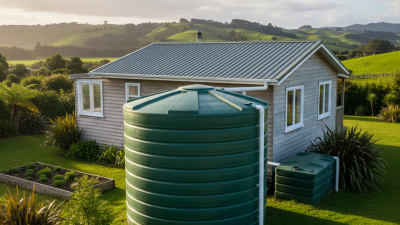
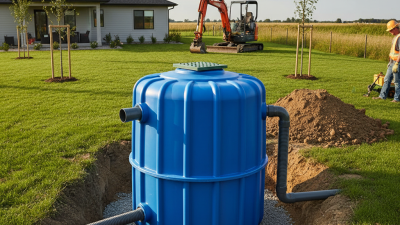
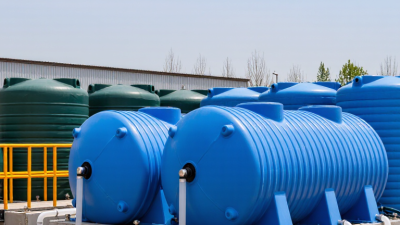
Large plastic tanks differ by material, capacity, and application. The ten practical types include vertical LLDPE tanks, horizontal LLDPE tanks, slimline tanks, underground HDPE tanks, cone-bottom tanks, flat-bottom tanks, double-wall polyethylene tanks, polypropylene process tanks, FRP composite tanks, and collapsible PVC or TPU bladders. Typical capacities range from 200 liters to over 50,000 liters. Vertical tanks suit farms and residential storage. Horizontal tanks support transport and low-clearance sites. Underground HDPE models preserve space, while cone-bottom designs improve drainage.
Material selection requires evidence, not assumptions. LLDPE usually offers impact resistance and flexible rotational molding. HDPE performs well underground when structural design is suitable. Polypropylene tolerates many process conditions, but temperature limits require checking. FRP composite tanks can serve larger industrial systems, although recycling routes remain less straightforward. For drinking water, buyers should request food-contact documentation and migration test results. The WHO and UNICEF Joint Monitoring Programme reported that 2.2 billion people lacked safely managed drinking water in 2022. Demand is real, but one tank cannot fit every climate or supply chain.
Tips: Match capacity with daily demand, refill frequency, and emergency reserve. Check UV exposure, wind loads, inlet size, and foundation strength. Request test certificates, wall-thickness data, and installation guidance. The OECD Global Plastics Outlook reported 353 million tonnes of plastic waste in 2019, with only 9% recycled. That figure should influence end-of-life planning. A cheaper tank may create hidden costs. Some specifications still need local engineering review.
Comparison by material, representative capacity, and common global application. Capacities reflect widely used commercial specifications rather than company-specific products.
How to read this chart: Sectional GRP and modular polyethylene tanks support the largest storage volumes for municipal, industrial, and agricultural projects. Vertical and underground HDPE tanks are widely used for domestic, commercial, and rainwater storage, while IBC and slimline tanks are suited to smaller sites or decentralized water supply.
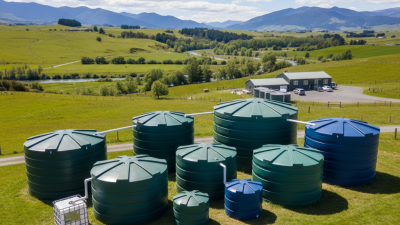
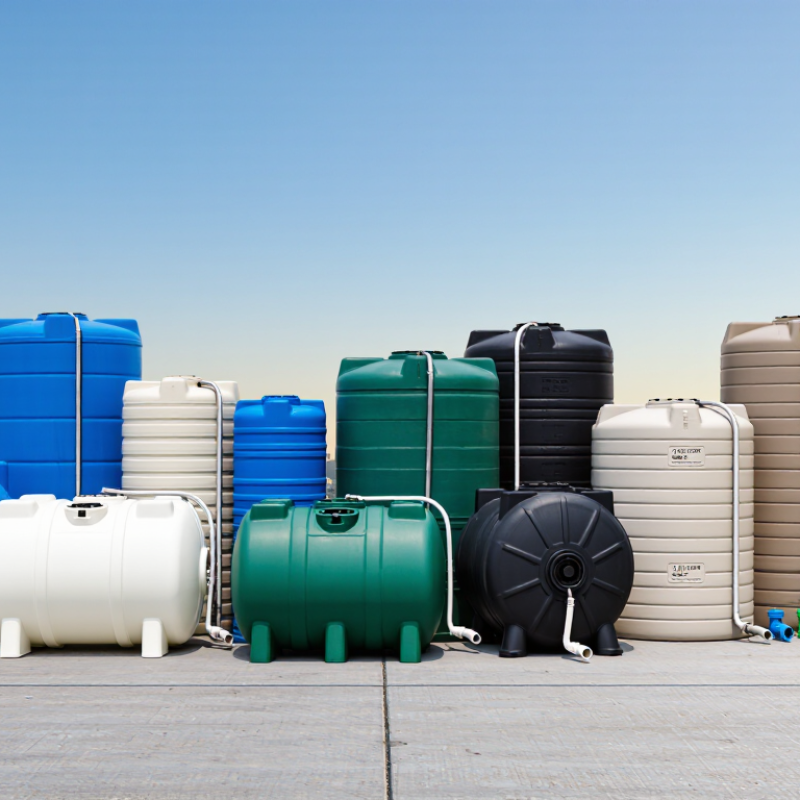
Large plastic water tanks vary by shape, access design, and storage capacity. Rotomolded polyethylene tanks from 500 to 50,000 liters suit farms, buildings, rainwater systems, and industrial sites. Small 500–1,000-liter vertical tanks fit narrow corners. Medium 1,500–5,000-liter tanks offer practical daily storage. Larger 10,000–25,000-liter models support irrigation or commercial reserves. Tanks reaching 50,000 liters usually require a carefully engineered foundation and delivery plan. Common types include vertical, horizontal, low-profile, cone-bottom, open-top, closed-top, baffled, rectangular, transport, and underground-compatible designs. Shape changes access, cleaning, stability, and usable volume.
ASTM D1998 provides important guidance for rotationally molded polyethylene tanks, including material, construction, and performance considerations. It should not be treated as a complete site approval. Buyers still need to verify local water-contact requirements, fittings, UV exposure, wind loads, and installation conditions. Wall thickness alone can mislead. Resin quality, molding consistency, support, and temperature also matter. A 50,000-liter tank is not automatically the better choice. In some projects, it creates unnecessary structural and maintenance demands. I have seen storage plans fail because the foundation was considered too late.
Tips: Confirm the actual working volume, not only the advertised capacity. Check manway size before purchase. Inspect weld-free molded surfaces, outlet placement, and overflow routing. Ask for test records and technical drawings. For drinking water, request suitable material documentation and cleanable internal details. Leave service clearance around the tank. Small omissions become expensive later.
Among the top 10 large plastic water tank types, 1,000-liter IBCs remain practical for global buyers. Their compact footprint supports forklifts, pallets, and temporary storage. However, capacity alone does not prove suitability. The FAO AQUASTAT database reports that agriculture uses roughly 70% of global freshwater withdrawals. This makes agricultural water tanks valuable for irrigation, livestock areas, and rainwater collection. Choose UV-stabilized polyethylene when tanks face intense sunlight. Dark algae growth can become a costly maintenance problem.
Chemical tanks require stricter assessment. Check the chemical’s concentration, temperature, density, and storage duration. Polyethylene resists many common chemicals, but it is not universally compatible. The tank wall may soften, crack, or permeate slowly. Use the supplier’s compatibility chart and the chemical Safety Data Sheet. ISO 16103 provides guidance for recycled plastics used in certain IBC applications, while UN performance testing may apply to regulated transport containers. Storage tanks and transport IBCs are not interchangeable. That distinction is easy to miss.
Tips: Measure the access route before ordering. A full 1,000-liter IBC weighs over one metric ton with water. Confirm the outlet size, pallet design, secondary containment, and cleaning access. WHO drinking-water guidance emphasizes hygienic protection during storage, yet buyers sometimes focus only on price. I have made that mistake in procurement reviews. A cheaper tank can create more work through fittings, odors, or early replacement. Consider actual sunlight, water quality, and seasonal demand, not only the advertised volume.
Large plastic water tanks serve different jobs, and capacity alone should not drive selection. The WHO/UNICEF Joint Monitoring Programme reported 2.2 billion people lacked safely managed drinking water in 2022. Reliable storage still matters. For 2,000–10,000 liters, vertical cylindrical, horizontal, slimline, and rainwater tanks suit homes, farms, and small facilities. Their compact footprints simplify transport. However, slimline models may need stronger anchoring against wind and uneven ground.
From 10,000 to 100,000 liters, underground cylindrical, underground rectangular, modular sectional, panel, cone-bottom, and fire-reserve tanks become more practical. Underground designs save surface space and reduce visual impact, but excavation, groundwater pressure, access covers, and drainage require engineering review. Modular and panel tanks can enter restricted sites in smaller components. They also allow capacity changes. Yet, more joints mean more inspection points. FAO AQUASTAT estimates agriculture accounts for about 70% of global freshwater withdrawals, making large storage valuable for irrigation planning. Still, water quality can deteriorate when tanks are oversized or poorly maintained.
Tips: Match tank material with the stored water, temperature, and cleaning method. Check certification for potable use. Measure delivery routes before ordering. A 100,000-liter tank may fit the calculation, not the site. Leave safe access around inspection openings, and confirm the foundation can carry a full tank. My practical concern is often overlooked: maintenance access matters more than an impressive capacity figure.
Top 10 Large Plastic Water Tank Types for Global Buyers
Large plastic water tanks differ in shape, wall thickness, and intended use. For potable water, request NSF/ANSI 61 evidence for the complete tank system, not only the resin. Check whether the certification covers the tank, lid, fittings, seals, and intended temperature range. A certificate alone is not enough. The production site should provide batch records, material declarations, and traceable test reports. Open the lid during inspection. Any strong chemical odor deserves investigation.
UN ratings require careful interpretation. They apply to approved packaging for certain regulated liquids, not automatically to ordinary water storage tanks. If a tank will transport a regulated substance, confirm the correct UN performance code, drop-test results, closure design, and marking rules. For drinking water transport, other destination requirements may apply. This point is often misunderstood.
UV protection matters in outdoor installations. Ask for UV-stabilized resin, exposure data, and a recommended service environment. Dark or opaque walls can reduce light penetration and algae growth, but color alone proves little. Check wall thickness near outlets, weld lines, and base supports. Export preparation should include dimensions, gross weight, pallet design, HS classification, labeling, installation instructions, and destination-language documents. Requirements change. Even experienced buyers miss updates. A pre-shipment inspection can reveal warped panels, loose fittings, or inadequate packaging before the container leaves the port.
| Tank Type | Typical Capacity | Common Material | Typical Applications | NSF/ANSI 61 Consideration | UN Rating | UV Protection | Key Export Requirements |
|---|---|---|---|---|---|---|---|
| Vertical Cylindrical Tank | 500–25,000 US gal (1,900–94,600 L) |
Linear polyethylene, commonly rotationally molded; some models use cross-linked polyethylene | Potable water storage, rainwater harvesting, agricultural and industrial water supply | Verify model-specific certification Required when the tank and wetted components are intended for certified drinking-water contact. |
Usually not applicable UN packaging approval is generally for dangerous goods, not stationary potable-water storage. |
Usually available Ask for UV-stabilizer specification and outdoor exposure guidance. |
Confirm wall thickness, pallet or blocking method, container loading plan, HS classification, product dimensions, country-of-origin marking, and destination drinking-water rules. |
| Horizontal Leg Tank | 200–10,000 US gal (760–37,850 L) |
Linear polyethylene with molded or attached support legs | Low-profile water storage, farms, construction sites, emergency supply and mobile installations | Verify certification scope Check whether the resin, fittings, gaskets and complete tank assembly are covered. |
Usually not applicable Do not treat a non-UN-rated water tank as a certified dangerous-goods package. |
Commonly included Outdoor tanks should be specified with a UV-stabilized resin suitable for the intended climate. |
Provide lifting and restraint instructions, center-of-gravity information where needed, export packaging, inspection access, and local vehicle or installation requirements. |
| Rectangular or Low-Profile Tank | 50–5,000 US gal (190–18,925 L) |
Polyethylene, polypropylene or engineered plastic panels | Space-limited installations, utility rooms, marine use, commercial buildings and under-deck storage | Project-specific verification NSF/ANSI 61 status may apply only to selected materials or components. |
Usually not applicable Capacity and shape alone do not establish a UN performance rating. |
Depends on construction Request UV-stabilizer data, especially for translucent or outdoor units. |
Check dimensional tolerances, access openings, support requirements, deformation limits, corrosion-resistant hardware, and export protection against distortion. |
| Intermediate Bulk Container (IBC) for Water | 275–330 US gal (1,000–1,250 L) |
High-density polyethylene bottle in a galvanized or plastic cage | Potable-water distribution, process water, temporary storage and reusable logistics | Verify potable-water suitability A UN marking does not prove drinking-water compliance; confirm food-contact and drinking-water documentation separately. |
Only if marked and certified Common dangerous-goods codes include 31HA1 or related designs, but approval must match the exact container and service. |
Limited or optional Opaque or UV-stabilized bottles are preferable for outdoor use; sunlight can promote algae growth and material aging. |
Verify UN mark, design type, test date and closure configuration when relevant; also check pallet dimensions, stack limits, cleaning records and transport regulations. |
| Cone-Bottom or Hopper Tank | 100–10,000 US gal (380–37,850 L) |
Polyethylene, polypropylene or fiberglass-reinforced plastic | Water treatment, dosing systems, sediment removal, process water and controlled drainage | Verify wetted components Certification should cover the liner, fittings, valves, seals and any internal coatings used with drinking water. |
Normally not applicable UN packaging approval is not a substitute for pressure, structural or potable-water certification. |
Application dependent Specify UV stabilization for outdoor units and confirm whether light protection is needed for the stored water. |
Export documents should include support-frame details, discharge-valve protection, lifting points, drain orientation, installation drawings and safe handling instructions. |
| Double-Wall or Secondary-Containment Tank | 250–20,000 US gal (950–75,700 L) |
Double-wall polyethylene or polyethylene with a compatible outer containment shell | Water treatment chemicals, process-water systems and installations requiring spill containment | Verify intended liquid service NSF/ANSI 61 applies to drinking-water contact materials, while secondary containment is a separate design function. |
Usually not applicable UN approval must be separately demonstrated if the tank is marketed for regulated dangerous goods. |
Generally specified outdoors Confirm UV resistance for both the primary tank and the containment layer. |
Provide leak-detection details, interstitial-space information, drainage controls, regulatory documentation, lifting instructions and destination-country chemical-storage compliance. |
| Underground Plastic Cistern | 500–20,000 US gal (1,900–75,700 L) |
Structured-wall polyethylene or molded polyethylene with engineered ribs | Rainwater harvesting, fire-water reserve, wastewater holding and underground potable-water storage | Verify potable-water configuration Certification may not cover the complete buried installation, piping or site-specific components. |
Not generally applicable Underground tanks require structural and installation validation rather than a UN transport rating. |
Normally low exposure UV protection is still relevant for above-ground access covers, pipework and temporary storage before installation. |
Confirm burial depth, groundwater conditions, backfill specification, traffic loading, anchoring, access covers, ventilation, lifting points and local building or plumbing codes. |
| Transport Water Tank with Baffles | 200–5,000 US gal (760–18,925 L) |
Polyethylene or fiberglass-reinforced plastic with internal baffles | Water hauling, municipal service, firefighting support, disaster relief and remote-site supply | Verify complete potable-water assembly Check tank material, fittings, hoses, valves and cleaning compatibility. |
Usually not a UN package Vehicle-mounted water tanks normally require transport-vehicle and road-safety compliance instead. |
Recommended for outdoor use Use opaque or UV-stabilized construction where water may remain in sunlight. |
Confirm vehicle mounting, axle load, baffle design, rollover restraint, emergency labeling, road regulations, lifting points and drain protection. |
| Modular Panel Tank | 1,000–500,000 US gal (3,785–1,892,500 L) |
Polyethylene, polypropylene, fiberglass-reinforced plastic or coated panel systems | Municipal storage, industrial facilities, commercial buildings, fire-water reserve and remote infrastructure | Verify liner and fittings For drinking water, certification must cover all wetted materials and the assembled system as required by the market. |
Not generally applicable These systems are installed on site and are not normally UN transport packages. |
Depends on panel system Specify UV-stable panels, covers and seals for exposed installations. |
Export planning should cover disassembled packing, corrosion protection, assembly drawings, foundation loads, seismic or wind design, spare parts and site-installation standards. |
| Flexible Bladder or Pillow Tank | 500–500,000 US gal (1,900–1,892,500 L) |
Flexible PVC, polyurethane or reinforced thermoplastic fabric | Emergency drinking water, rainwater, irrigation, remote camps, humanitarian response and temporary storage | Verify fabric and fittings Potable-water certification must cover the membrane, seams, valves, hoses and any internal contact surfaces. |
Normally not applicable Flexible storage bladders are generally installed products, not UN-certified dangerous-goods packages. |
Use an opaque cover where possible UV resistance varies significantly by fabric and coating; confirm expected service life and storage conditions. |
Export packaging should prevent puncture and contamination; provide folding instructions, repair kits, disinfection procedures, site protection requirements and temperature limits. |
Buyer verification note: NSF/ANSI 61 certification, when required, must be confirmed for the exact tank model and all drinking-water-contact components. A UN packaging mark is applicable only when the complete package has the relevant approval for the regulated substance and transport mode; it does not by itself confirm potable-water suitability. Always check destination-country plumbing, drinking-water, customs, labeling, electrical, structural and installation requirements before shipment.