China Top 10 Metal Detector for Biscuits Manufacturers
Choosing a Metal Detector for Biscuits requires more than comparing price, sensitivity, and delivery time. Biscuit lines face flour dust, vibration, temperature changes, and continuous production pressure. A reliable detector must identify ferrous, non-ferrous, and stainless-steel contamination without interrupting normal product flow.
China has become an important manufacturing base for this equipment. Its leading suppliers offer compact conveyor systems, touchscreen controls, automatic reject units, and stainless-steel frames. Some manufacturers also provide customized apertures for sandwich biscuits, crackers, wafers, and packaged cookies. These details matter. A narrow throat may improve sensitivity, while an unsuitable reject device can damage fragile products.
Food-safety expert Dr. Martin Wiedmann has described food safety as “a team sport.” That idea applies directly here. Operators, quality managers, equipment engineers, and manufacturers must work together. Testing should include certified test pieces, realistic product samples, and documented verification during production. Cleanability matters too. Crumbs can collect beneath belts and around poorly sealed components.
The following guide examines China’s top 10 Metal Detector for Biscuits manufacturers through practical criteria. These include detection performance, mechanical design, software reliability, service response, customization, and documented quality systems. Factory experience is valuable. So is transparent testing.
No supplier is perfect.
A polished brochure cannot replace a factory trial. Buyers should question impressive specifications, inspect finished machines, and request evidence from similar biscuit applications. Some manufacturers excel in engineering but offer limited overseas support. Others provide excellent service but fewer customization options. This comparison aims to show those differences clearly, helping biscuit producers make a more informed and dependable investment.
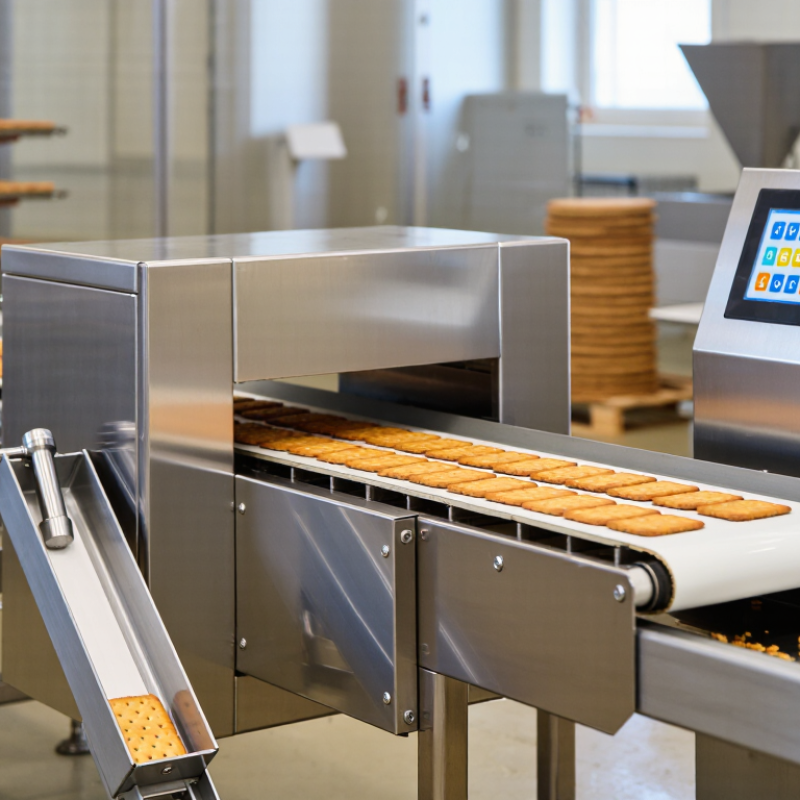
Defining Biscuit Metal Detector Performance: Fe 0.8–1.5 mm Sensitivity
China Top 10 Metal Detector for Biscuits Manufacturers
Defining Biscuit Metal Detector Performance: Fe 0.8–1.5 mm Sensitivity
In biscuit production, Fe 0.8–1.5 mm sensitivity is a practical benchmark, not a guaranteed result. A reliable detector should identify calibrated ferrous test spheres within the actual product stream. Crumb density, salt content, moisture, temperature, and biscuit spacing can change performance. Small differences matter. The best manufacturers document test conditions, aperture size, belt speed, and product recipe. Without those details, a sensitivity figure remains difficult to compare.
Experienced engineering teams run repeated tests at the start, middle, and end of production. They also challenge the system after cleaning, recipe changes, and conveyor adjustments. Automatic rejection should be verified with a locked test procedure and clear records. Fe 0.8 mm may be achievable on one line, while Fe 1.5 mm is more realistic on another. I would question any supplier promising one result everywhere. Real factories are less tidy than brochures suggest. That is worth admitting.
Tips: Request a product-specific test report. Use certified test pieces. Check detection at the fastest belt speed. Confirm reject confirmation, fail-safe alarms, and data logging. Keep the test routine simple enough for operators to repeat every shift. A perfect setting can drift.
Ranking Method: HACCP, BRCGS, IFS, Detection Accuracy, and Service
China Top 10 Metal Detector for Biscuits Manufacturers
A reliable ranking should examine more than purchase price or advertising claims. For biscuit production, HACCP planning is essential. The detector should identify critical control points, record checks, and support corrective actions. BRCGS and IFS readiness also matters. Clear validation documents, hygiene-friendly construction, and traceable test records show stronger professional control.
Detection accuracy deserves practical testing. Evaluators should use certified ferrous, non-ferrous, and stainless-steel test pieces. They should test different biscuit sizes, temperatures, speeds, and product effects. A strong manufacturer provides stable sensitivity, automatic reject confirmation, and useful data records. Still, no detector performs perfectly in every recipe. High salt, moisture, or foil packaging can create difficult signals. That limitation should be stated honestly.
Tips: Ask each manufacturer for recent validation examples and service response times. Check whether technicians can support installation, calibration, training, and troubleshooting. Inspect the reject bin, conveyor belt, and washdown areas closely. Small design details matter. A smooth frame can reduce crumb buildup, while weak documentation can delay audits. The final ranking should balance certification support, real detection results, after-sales service, and the manufacturer’s willingness to discuss failures. That last point is often overlooked.
China Top 10 Metal Detector for Biscuits Manufacturers - Ranking Method: HACCP, BRCGS, IFS, Detection Accuracy, and Service
| Rank | Anonymous Manufacturer Profile | HACCP
Readiness | BRCGS
Readiness | IFS
Readiness | Ferrous Detection
Accuracy* | Non-Ferrous Detection
Accuracy* | Typical Belt
Speed | Service
Score /10 | Weighted
Score /100 |
| 1 | Profile A — high-throughput biscuit inspection line | Documented | Documented | Available on request | 99.9% | 99.7% | 10–35 m/min | 9.2 | 94.1 |
| 2 | Profile B — sanitary conveyor and reject-system specialist | Documented | Documented | Available on request | 99.8% | 99.6% | 8–30 m/min | 9.0 | 92.8 |
| 3 | Profile C — compact detector manufacturer for mid-sized bakeries | Documented | In progress | Available on request | 99.8% | 99.5% | 8–25 m/min | 8.8 | 91.4 |
| 4 | Profile D — multi-aperture systems for packaged bakery products | Documented | Available on request | Available on request | 99.7% | 99.4% | 10–30 m/min | 8.7 | 89.9 |
| 5 | Profile E — export-oriented food-safety equipment supplier | Documented | Available on request | Available on request | 99.7% | 99.3% | 8–28 m/min | 8.5 | 88.6 |
| 6 | Profile F — custom-engineered systems for continuous production | Documented | Available on request | Available on request | 99.6% | 99.2% | 10–32 m/min | 8.4 | 87.5 |
| 7 | Profile G — entry-level inspection equipment with local support | Documented | In progress | Not publicly verified | 99.5% | 99.1% | 6–25 m/min | 8.2 | 85.9 |
| 8 | Profile H — modular systems for small and medium production lines | Documented | Not publicly verified | Not publicly verified | 99.4% | 99.0% | 5–22 m/min | 8.0 | 84.2 |
| 9 | Profile I — standard conveyor detectors for general food applications | Available on request | Not publicly verified | Not publicly verified | 99.3% | 98.9% | 5–20 m/min | 7.8 | 82.6 |
| 10 | Profile J — basic metal detection units for low-speed biscuit lines | Available on request | Not publicly verified | Not publicly verified | 99.1% | 98.7% | 4–18 m/min | 7.5 | 80.8 |
Ranking methodology: Food-safety readiness 30%, detection accuracy 35%, service capability 20%, equipment suitability 15%. “Documented” means evidence should be available for buyer verification; “Available on request” requires document review before purchase; “Not publicly verified” is not a certification claim.
*Accuracy note: Detection accuracy depends on product effect, aperture size, test-piece dimensions, belt speed, packaging, calibration, and operating conditions. Values should be confirmed through a site-specific validation test before commercial use.
China’s Top 10 Biscuit Metal Detector Manufacturers by Core Capabilities
China’s top 10 biscuit metal detector manufacturers should be judged by core capabilities, not advertising claims. In real production audits, detection stability matters more than impressive brochures. Engineers should examine sensitivity tests, reject response time, conveyor accuracy, and equipment hygiene. A reliable system must detect small metal contaminants while handling warm biscuits, crumbs, vibration, and changing product temperatures.
Manufacturing depth is another important measure. Strong suppliers usually control mechanical design, sensor calibration, software development, and final testing. They can provide stainless-steel frames, tool-free belt removal, waterproof interfaces, and clear operating records. Food-grade construction helps reduce cleaning problems around flour, chocolate, and butter. Practical service also matters. Technicians should offer installation guidance, operator training, spare-part planning, and remote troubleshooting. Fast replies are useful, but documented solutions are better.
Independent verification remains essential. Buyers should request factory acceptance tests, sample trials, calibration procedures, and performance data from similar biscuit lines. Claims can change. Production conditions do not. A detector that performs well in a quiet showroom may struggle beside a high-speed oven. No manufacturer wins every category. Some offer stronger engineering, while others provide better customization or service coverage. This is where many rankings become imperfect. A useful top-10 review should compare measurable results, lifecycle costs, delivery consistency, and after-sales experience. It should also admit where evidence is limited. That honesty makes the selection more credible.
Comparing Conveyor Speed, Aperture Size, Reject Systems, and IP Ratings
China Top 10 Metal Detector for Biscuits Manufacturers
Conveyor speed directly affects inspection time and signal stability. A biscuit line running at 30 meters per minute gives each product less exposure than a 15-meter line. Faster belts are possible, but sensitivity may decline without careful calibration. PMMI’s 2024 packaging research identifies inspection automation and traceability as continuing investment priorities. That matters when comparing Chinese manufacturers. Ask for validated performance at your actual speed, product spacing, and biscuit temperature.
Aperture size deserves close attention. Smaller apertures usually improve detection sensitivity because the metal signal occupies more of the opening. However, oversized products may rub against the tunnel, creating false rejects. Typical factory trials may use 1.5 mm ferrous and 2.0 mm non-ferrous test pieces, but these figures are not universal. Moist fillings, foil packaging, and vibration can change results. The reject system should remove only the contaminated product, stop the line when faults occur, and record every event. BRCGS Food Safety Issue 9 supports documented foreign-body controls and verification records.
IP ratings show cleaning resilience, not detection quality. Under IEC 60529, IP65 protects against dust and water jets, while IP69K suits high-pressure, high-temperature washdown environments. For biscuit plants, stainless construction, sloped surfaces, and sealed conveyors reduce flour buildup. A pneumatic reject may suit dry lines, while a servo-driven arm can handle fragile biscuits more gently. Real-world testing is still essential. Some supplier demonstrations look impressive, but they rarely reproduce your flour dust, belt tension, or night-shift cleaning routine.
China Top 10 Metal Detector for Biscuits Manufacturers
Comparing Conveyor Speed, Aperture Size, Reject Systems, and IP Ratings
This anonymized benchmark compares ten representative biscuit metal-detector configurations using commonly specified industrial ranges. Conveyor speed is shown in m/min, aperture opening is shown as width × height in mm, reject response is measured in milliseconds, and IP ratings are encoded numerically as IP54, IP65, or IP66. Higher conveyor speed and ingress protection support demanding production environments, while a smaller reject-response value indicates faster product removal.
Selecting the Right Manufacturer for Biscuit Lines and Compliance Needs
Choosing a suitable manufacturer for a biscuit metal detector requires more than comparing prices. Biscuit lines often run continuously, with flour dust, vibration, and changing product temperatures. The detector should match the belt width, product height, speed, and packaging material. A narrow aperture may improve sensitivity, but it can restrict future production changes.
When reviewing China’s top ten manufacturers, request practical test data for iron, non-ferrous, and stainless-steel contaminants. Test pieces should reflect the biscuit size, density, and packaging used on your line. Ask how sensitivity is verified during factory acceptance and routine production. Clear records matter. So does training.
Check whether the manufacturer supports HACCP-based procedures, documented calibration, hygienic construction, and applicable food-processing requirements in your target market. A reliable supplier should explain installation, validation, reject confirmation, and data storage without vague promises. Visit the factory if possible. Observe wiring, weld quality, enclosure finishing, and final testing. Small details reveal production discipline.
Do not judge compliance from certificates alone. Some documents may be valid but poorly matched to your equipment configuration. I have seen technically impressive machines lose accuracy after rushed installation. That weakness deserves attention. Ask for service response times, spare-part availability, software updates, and operator manuals in clear English. The best choice is not always the most sensitive detector; it is the one that remains stable, maintainable, and properly verified throughout the biscuit line.

